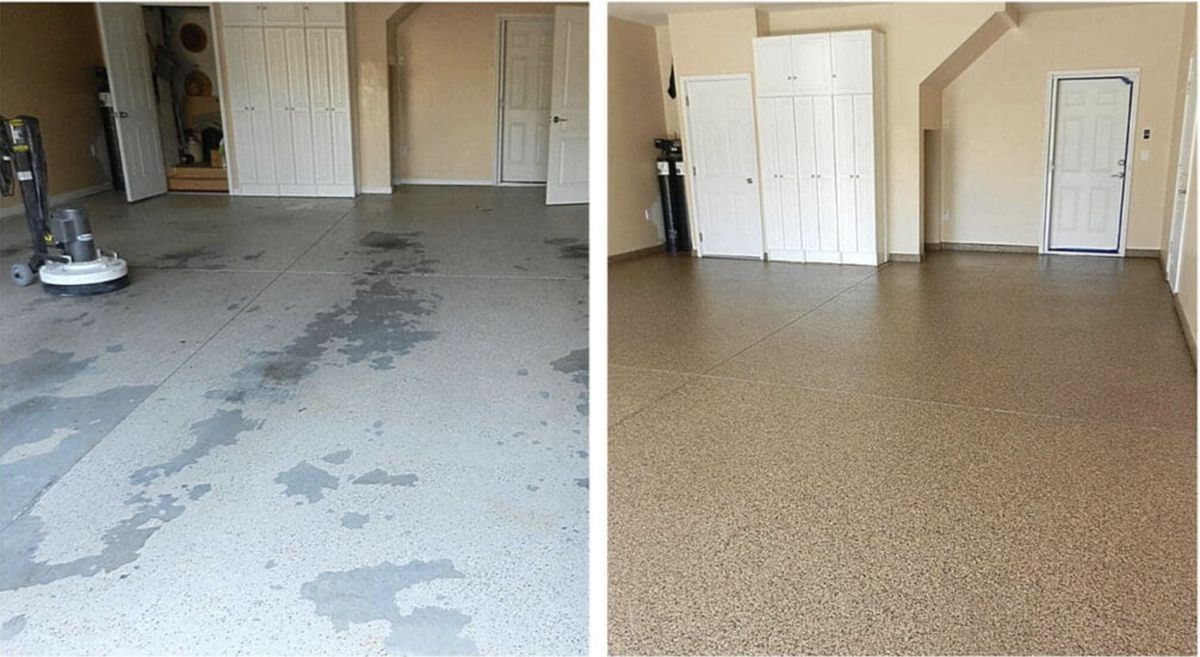
Garage Floor Epoxy in Yuma, AZ
Coatings specified for the sunniest, hottest garage floors in the country — and scheduled around when you are actually here.
Why Coatings Fail Here and Not in Phoenix Suburbs
The failure people describe is always the same. The floor looks perfect for a season, then patches shaped exactly like tire tread lift off when a vehicle backs out. It gets blamed on a bad batch of product. It is almost never the product.
Here is the actual mechanism. A tire that has been rolling on Yuma asphalt in summer holds serious heat for a long time after you park. Sitting on a coating, it softens the film directly beneath the contact patch. As the rubber cools it contracts and grips. Reverse out in the morning and the softened film goes with the tire.
The reason this happens to some floors and not others is hardness. A film that reached full cure resists it completely. A film that was too thin, cured too fast in the heat, or never bonded to the slab does not. So the question to ask a contractor is not which brand they use — it is total dry film thickness in mils, and whether the wear layer is polyaspartic.
The second local failure is ultraviolet. Yuma receives around ninety percent of the sunshine that is theoretically possible, and low winter sun reaches a long way into a garage with the door up. Standard clear epoxy ambers and then chalks under that load. A UV-stable clear does not. It is the same layer that solves the tire problem, which is why it earns its cost twice on almost every job here.
Installing in a Climate That Fights the Chemistry
Resin cures faster as temperature rises, and that is not a small effect. Working time that would be comfortable in a mild climate collapses to a few minutes on a hot Yuma slab, and a coating that skins over before it levels keeps every roller mark permanently.
So the schedule is part of the specification. We start at first light, stage material in the shade and keep it cool until the moment it is mixed, move air through the space, and switch to a slower hardener through the summer. On the worst weeks we will tell you to wait rather than fight it.
Prep does not change with the weather. Every slab gets diamond ground, edges included, with dust pulled through HEPA collection. We do not acid etch. Etching leaves residue and profiles unevenly, and it is the reason most of the peeled floors we grind off ever peeled.
Cracks get chased open and filled. Yuma slabs move for local reasons — caliche layers under the pad make for uneven bearing, and the annual temperature swing is enormous. A static crack disappears under the coating. One that is still moving gets a flexible filler and may show faintly, and we say which kind you have before you pay rather than after.
Scheduling Around Winter Visitors
Yuma's population swells enormously from November through March and thins out again for the summer, and that rhythm shapes this trade more than any other factor except heat.
If you are here for the season, the calendar is tight and everyone wants work done in the same four months. Book early. A one-day polyaspartic build is genuinely useful in this situation, because you lose a single day of garage access rather than most of a week.
If you leave for the summer, the better plan is usually to have the work done while you are gone. We coordinate access with a neighbor or property manager, send photos at each stage, and the floor has months to fully cure and off-gas before you walk in the door in October. Summer is also our quieter season, so scheduling is easier.
Either way, tell us your dates at the estimate. Half of what makes a project smooth here is picking the right window rather than the right product.
What It Costs in Yuma
Garage size sets the starting point. A single-car bay, a standard two-car garage and an oversized or RV-depth garage are each quoted on measured square footage.
Removing a failed coating adds labor and is the most common reason two quotes differ so much. In this market that old coating is frequently a big-box kit that lifted in its first summer.
Flake versus solid color is your call, and both are quoted during the free estimate. In a desert climate flake is usually worth it, because the pattern hides the fine blown dust that settles between cleanings.
UV-stable clear is a separate line and the one we argue hardest for.
Moisture mitigation is needed less often in Yuma than in humid regions, but older slabs poured without a vapor barrier still test high near irrigated ground, so we measure rather than assume.
Every quote is itemized and states the total mil thickness. That single number tells you more about what you are buying than any brand name will.